


Quick answer: Use WebSockets when the server must push updates instantly — live orders, chat, tracking, dashboards. Use simpler polling or server-sent events when a few seconds of delay is fine. Real-time features add roughly QAR 30,000–90,000 to a product\u2019s budget depending on scale, and they are what separate an app that feels alive from one that feels like a form.
Some products only feel alive when they react the instant something changes. At Hirodots we build these real-time experiences across very different industries, and the same pattern shows up again and again: the moment information is even a few seconds stale, the whole product loses trust. Here is how we approach it.
What counts as a real-time feature?
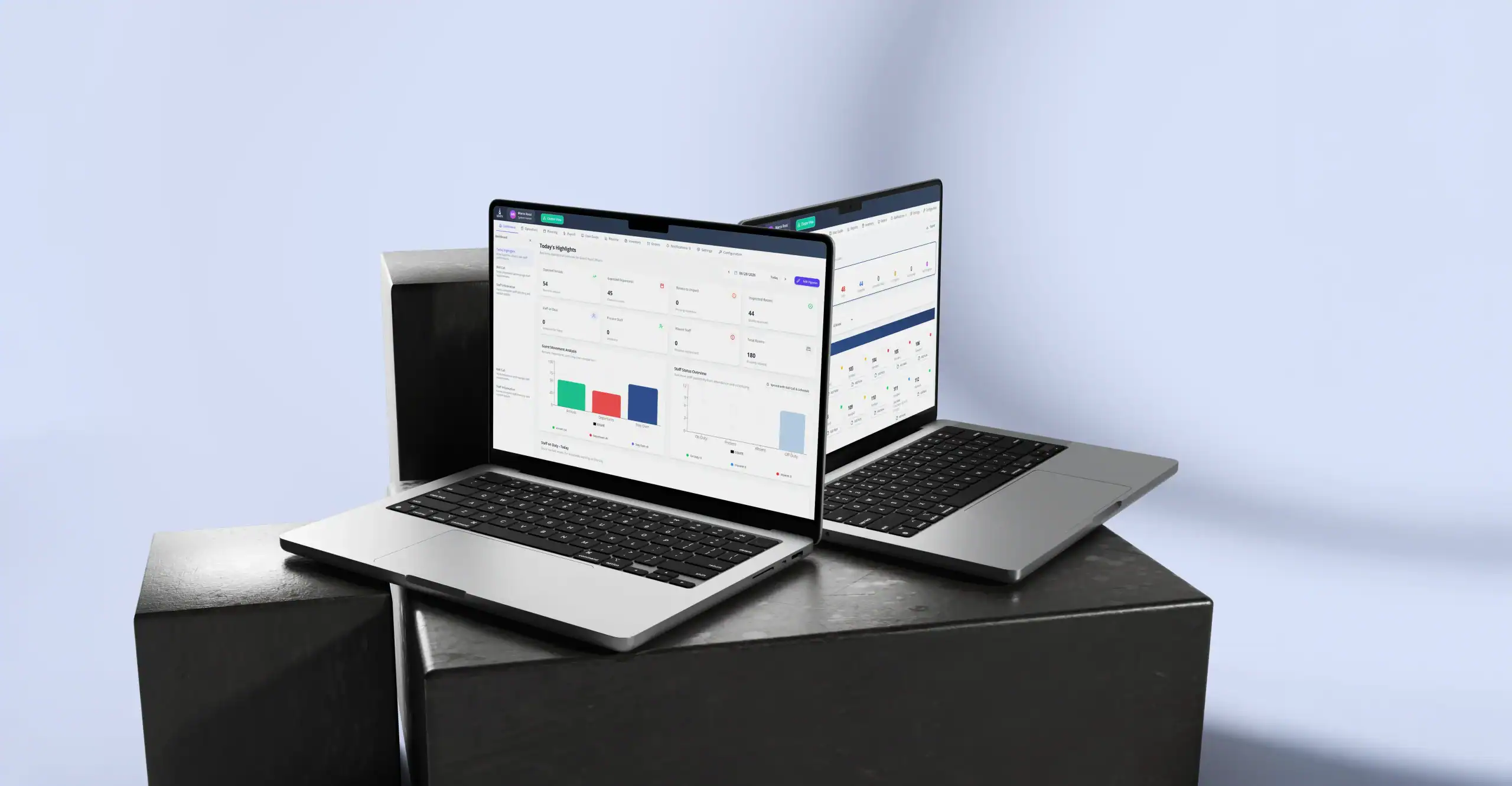
A real-time feature updates every relevant screen the moment something happens, without anyone refreshing. In Xionys, our hotel operations platform, room status is tracked live so housekeeping and the front desk are always in sync. In Heronys, vehicles are tracked in real time and valets are dispatched instantly. In Hairaholic, bookings, changes and cancellations trigger real-time notifications so no two clients ever land on the same slot. Different industries, the same underlying need.
How do WebSockets make this work?
Traditional web pages ask the server “anything new?” over and over. A WebSocket instead keeps a single connection open so the server can push updates the instant they happen. That shift — from repeatedly asking to simply being told — is what makes live room boards, instant dispatch and real-time schedules feel immediate rather than laggy, while using far less overhead than constant polling.
Why is real-time harder than it looks?
The demo is easy; the edge cases are where products break. Connections drop and must recover gracefully, two users can act on the same data at once — Hairaholic has to stop two bookings landing on one therapist at the same minute — and devices go offline mid-action on a hotel forecourt or a busy salon floor. We design for that messy middle from the start, because that is where a real-time product earns or loses a user’s trust.
Real-time, done right
Live features are some of the most satisfying things we build — and some of the least forgiving. Across nine years of delivery work for clients in Qatar, the GCC and beyond, we have learned to treat reliability as part of the feature, not an afterthought. If your product needs to feel truly live, our team in Lusail would be glad to help: [email protected].
WebSockets vs polling vs SSE — the honest comparison
| Technique | Latency | Server cost | Use it for |
|---|---|---|---|
| Polling | Seconds | Wasteful at scale | Simple status checks, low-traffic admin tools |
| Server-sent events (SSE) | Sub-second, one-way | Cheap | Live feeds, notifications, dashboards that only read |
| WebSockets | Instant, two-way | Needs connection management | Chat, live orders, collaborative tools, tracking |
Where we use real-time in Qatar projects
Live order boards in the Al Gharafa Bakery app, operational dashboards in XIONYS, and service-request tracking in Heronys all push updates the moment they happen. Architecturally this builds on the foundations from our scalable backend guide — real-time is a feature of a well-designed backend, not a bolt-on.

How much does a real-time feature cost, and how long does it take?
For the Qatar projects we scope, a first real-time feature usually lands between QAR 30,000 and 90,000 on top of the base product. The spread comes from three things: how many concurrent users must stay connected at once, whether updates must be delivered in order and never lost (a payment or valet dispatch) or can simply be refreshed (a dashboard tile), and whether the mobile app needs to recover cleanly after the phone sleeps or loses signal. A single live-status screen for a few hundred staff sits at the low end; a guest-facing feature with thousands of connections, offline recovery and audit trails sits at the top.
On timeline, expect three to six weeks for the first real-time feature inside an existing app, and longer if the backend was never designed to push events. The work that takes time is rarely the socket itself: it is deciding the event model, adding a message queue so nothing is lost when a server restarts, and testing reconnection on real Qatari mobile networks rather than on office Wi-Fi.
Five questions to answer before you commit to real-time
- Does a delay of five seconds change a decision? If a manager would act differently with a five-second-old number, you need push. If not, polling every 30 seconds is cheaper and simpler.
- Who is on the other end of the update? Staff on a shared dashboard tolerate a spinner; a guest waiting for a car does not. Guest-facing features need the stricter delivery guarantees.
- What happens when the connection drops? Every real-time screen needs an honest “last updated” state and an automatic resync. This is where most rushed implementations fail.
- How many devices at peak, not on average? Hotel check-out at 11:00 or a bakery promotion at Eid sets the number your infrastructure must hold.
- Who owns the backend after launch? Real-time systems need monitoring. Agree on who watches connection counts and error rates in month two, not just at go-live.
Answer those five and the build decision usually makes itself. In Xionys the answer to the first question was an immediate yes: housekeeping cannot act on a room status that is minutes old. In Heronys it was yes for dispatch and no for reporting, so the reports poll while the dispatch board streams. That split is the difference between a system that costs what it should and one that is over-engineered everywhere.
Frequently asked questions
How much do real-time features cost to build?
Adding real-time capability — live updates, chat or tracking — typically adds QAR 30,000–90,000 to a product budget at Hirodots, depending on concurrency and infrastructure. Products built around real-time from the start fall into the complex bracket (QAR 280,000+) of our 2026 cost guide.
When should I use WebSockets instead of polling?
Use WebSockets when updates must appear instantly and flow both ways — chat, live orders, collaborative editing, vehicle tracking. If a delay of a few seconds is acceptable and data only flows one way, polling or server-sent events are simpler and cheaper to run.
Do WebSockets scale?
Yes, with the right plumbing: sticky sessions or a pub/sub layer (like Redis) behind a load balancer, heartbeats to clean up dead connections, and automatic reconnection on the client. Managed services such as Pusher or Ably can carry the load until self-hosting becomes worthwhile.
Do real-time features work on weak mobile networks?
They must — which is why we design reconnection and offline states first. The client queues actions while disconnected, re-syncs on reconnect, and the interface always shows what is live and what is pending, in Arabic and English alike.


